Levers for Change
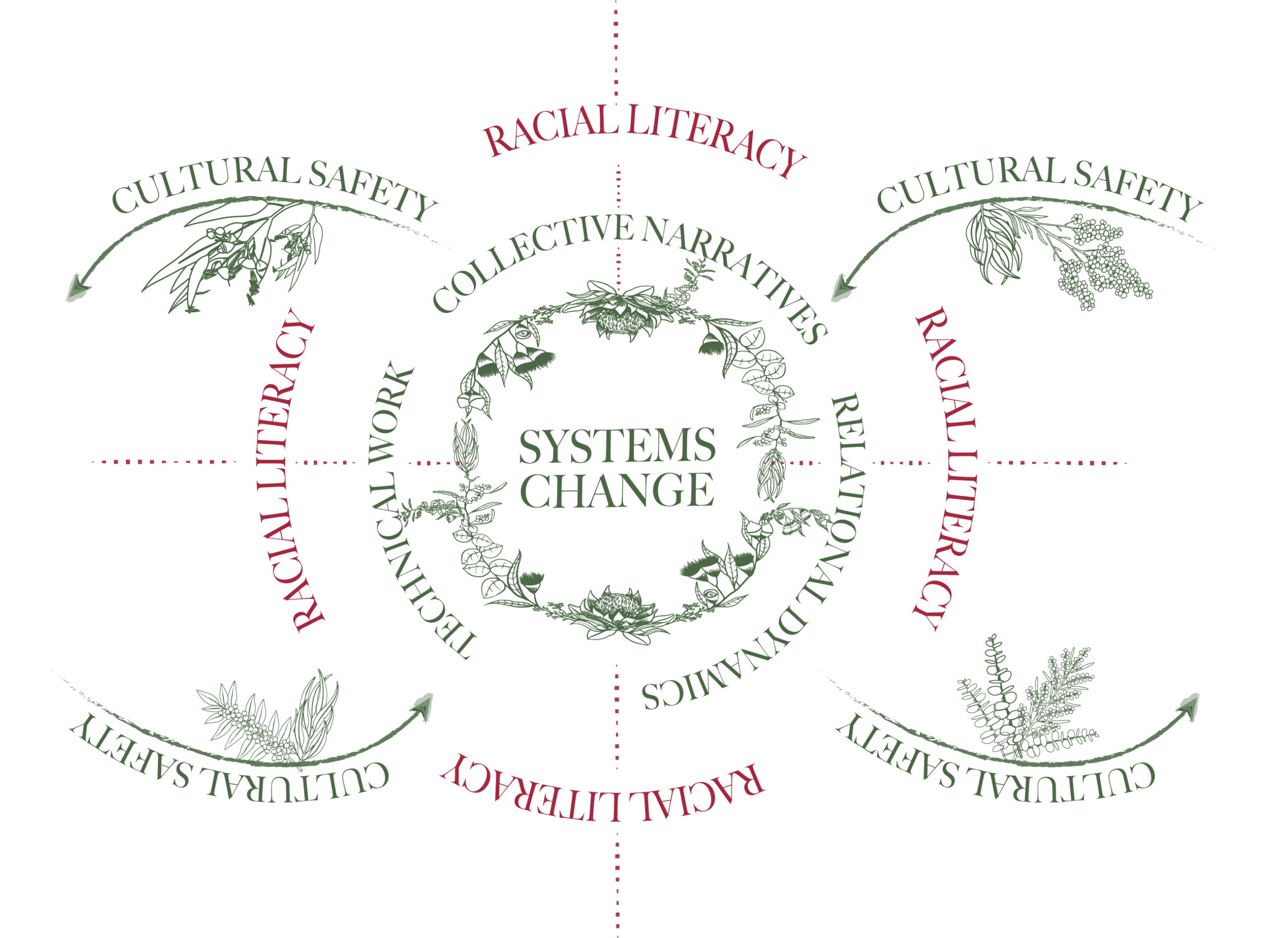
Collective Narratives
These are the shared stories an organisation and its communities tell about who they are, who belongs, whose knowledge counts, and what is possible. Unlike individual beliefs, these narratives are relational and communal, and are reinforced or challenged through everyday practices, policies and language.
Relational Dynamics
Refers to the quality, structure, and distribution of power within and between the relationships that hold a system together. Who is in relationship with whom, whose voice carries weight, who is trusted as an expert, and who is positioned as a recipient of service rather than a co-creator of solutions — these relational patterns shape what a system can and cannot do.
Technical Work
This is the formal, tangible elements of a system that can be seen, measured, and documented — the policies, legislation, funding arrangements, organisational roles, service models, data systems, and governance mechanisms that give a system its shape. Includes research that is done to understand what works and what doesn’t.
Racial literacy
Racial literacy sits as a cross-cutting capacity, positioned between the systems layers and cultural safety. It concerns how people make sense of race — the recognition that everyone, regardless of their views, already holds some framework for understanding it, shaped by what they have read, heard, experienced, and absorbed. Anti-racism efforts often narrow into slogans or rules, which misses this: people are not blank slates. Before you can shift how someone thinks about race, you need to understand how they currently think about it.
Cultural safety feedback spiral
These concepts form a self-reinforcing spiral
- Collective narratives shape collective norms and inform assumptions and stereotypes. They also shape what feels safe and what feels threatening or welcoming.
- Cultural safety (or its absence) determines who can challenge those narratives
- Racial literacy is what enables people — individually and institutionally — to read the context, see the narratives, name the harm, and act
- As racial literacy grows, it becomes possible to identify and disrupt narratives that undermine cultural safety
As cultural safety deepens, more voices enter the narrative spaces, enriching collective understanding and challenging dominant narratives.
Cultural Safety and Anti-Racism: A Brief Conceptual Review
This document provides an overview of the origins of cultural safety, the ways it has been conceptualised, utilised and measured in a range of settings. It is not designed to be prescriptive, but rather to provide some anchor points and illustrations for how others have been thinking about cultural safety.
Skip to PDF contentWhite Supremacy Culture in Organizations
This is a list of characteristics of white supremacy culture that show up in our organizations. Organizational culture is powerful precisely because it is so pervasive, impacting every part of our work; at the same time, it is very difficult to name or identify.
Skip to PDF contentKey Concepts and Definitions for Building Racial Literacy
This guide has been created to give the user tools to understand the history and sociology of race, racism, and antiracism. These concepts contribute to enhancing racial literacy in society. .
Skip to PDF contentFive Common Myths Misconceptions About Racism
This self-reflection and education guide aims to support and enhance understandings of race, racism, and anti-racism in Australia. The guide seeks to encourage us to stop and think about the various opinions, stories, and terms we encounter about race, racism, and anti-racism and empowers us to identify, and think critically about common myths and misconceptions.
Skip to PDF contentDecolonising and Critical Approaches to Community Arts
From early 2022 to early 2025, in partnership with nine arts organisations, the Future Reset program utilised community-based art projects and activations across 26 locations in Victoria, designed by young creatives in collaboration with young people in their communities (aged 12-25). The aim was to facilitate social connectedness and increased mental health and wellbeing for young people in the context of post-COVID recovery. The broader program adopted a collective impact approach and was guided by the notions of collaboration, relationality, and equity.
This document is an overview of literature that was a part of the research conducted by Victoria University as a partner in Future Reset. The components identified across the papers shape outcomes at multiple levels — for individuals, communities, and society. They show how these levels are deeply interconnected: safe, supportive spaces must be built through relationship, participation, and a sense of shared community. Within these spaces, people make meaning, shape their identities, and develop stories that challenge dominant narratives and build critical awareness. Being in community offers more than wellbeing — it enables healing, transformation, and social action.
Skip to PDF content